Holland Snow Globes
The Netherlands (Holland), is a country located in north-western Europe. The name means Wooded Land and is characterised by low-lying, flat land with many lakes, rivers, and canals. A fair proportion consists or land reclaimed from the sea and water ways. Windmills have been used extensively to drain the land.


The Tulip flower is a typical Dutch icon, which originated when samples were brought from the Türkey area in the 15th century. The wet, low-lying conditions of the Netherlands made for perfect growing conditions.
From March to May, whole areas of tulips in Holland flower. They are a common feature of snow globes, around the bases or being carried within the globes by people in national dress.
The Dutch black and white Friesian cow, is another important part of the nation’s identity, and part of the renowned dairy industry, and in particular cheese production like Gouda and Edam


Windmills and tourist boats are a prominent feature of many Dutch globes. The globe on the left one of our older ones, has mostly lost the red Holland text on the white sign at the front
The Netherlands has more than 1200 windmills, many of which are still in operation. They have been common in Holland since the Middle Ages: the earliest mention being from 1221AD.
Many globes show the classic Dutch windmill (thatched roof and white sails),
They have two main purposes: polder mills, pump water, draining the land, and industrial mills, e.g. for grinding grain, sawing wood, and making paper.
Windmills are still used to keep land dry that has been claimed from the sea. Without the windmills, lots of the Netherlands would be underwater.

Amsterdam is the capital and largest city of the Kingdom of the Netherlands. It is somtimes called the "Venice of the North", due to its canals. It was originally a small fishing village in the 12th century. The globe shows the famous, opulent canal houses, home to some of the wealthiest citizens of Amsterdam during the 17th century.
Many residents live on houseboats along the canals,with tourist boats travelling past.

The coat of arms of Amsterdam on the base of the globe features a red shield with three silver Saint Andrew's Crosses from at least 1505, when the city was a prominent fishing town.
Two golden lions were added in the 16th century and represent the Netherlands as a whole.
The Imperial Crown of Austria from 1498, symbolizes the city's rich history and resilience ( a sign of gratitude from Emperor Maximilian I for financial support from the city.) The black pale is thought to symbolize the fundamental Amstel River.
The barely visible motto "Heldhaftig, Vastberaden, Barmhartig," translates to "Heroic, Determined, Compassionate." was added after World War II due to the bravery of Amsterdam's citizens during the Nazi occupation.
A stone bridge across the canal and canal houses are inside the globe

The Hague is the capital city of the South Holland province of the Netherlands. It is the third-largest city in the Netherlands. The Hague is the country's administrative centre and its seat of government,
The 13thC Binnenhof is a complex of buildings in the city centre, for the government and Prime Minister .


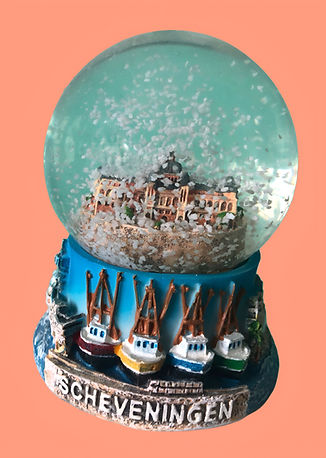
Scheveningen is a seaside resort with a long, sandy beach, an esplanade, a pier, and a lighthouse.
The globe features the The Kurhaus a prominent beach and pier side hotel which has also been called the Grand Hotel.The Kurhaus was built between 1884 and 1885. The base advertises that as well as a tourist destination Scheveningen has a fishing fleet.
This globe is from Rotterdam and celebrates Feyenoord, a professional football club based in Rotterdam, with a history from 1908 and named after its local area. The Stadion Feijenoord, nicknamed De Kuip (The Tub), is the second largest stadium in the Netherlands and features within the globe.
The base shows the Euromast, the Kunstkubus, cube shaped, yellow houses on pylons designed to look like parts of a tree, and the The Markthal a residential and office building with a market hall underneath
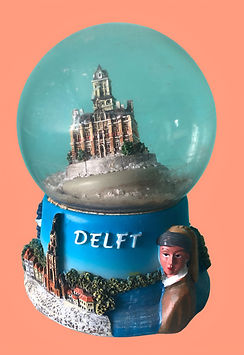
The city's name, Delft comes from the word delven, meaning to delve or dig, and dates back to 1075.
The Nieuwe Kerk seen in the globe is a Protestant church in the city

